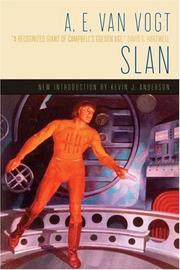
A.E. Van Vogt
A.E. Van Vogt stands as one of the towering figures of science fiction’s Golden Age, a writer whose imaginative scope and relentless narrative momentum helped define what the genre could be. His 1941 Hugo Award-winning novel Slan exemplifies his distinctive approach: a sweeping adventure built on a genuinely novel premise, where persecuted telepathic mutants navigate a hostile world while uncovering vast conspiracies that span their entire civilization. The book’s recognition from the field’s most prestigious award was fitting vindication for a writer who had mastered the art of the page-turner while exploring genuine philosophical questions about evolution, acceptance, and power.
Van Vogt’s significance lies not just in individual masterworks but in his influence on how subsequent science fiction writers approached world-building and plot construction. His stories pulse with what he called the “Cosmic Zoom”—a technique of shifting perspective and scale to create a sense of vastness and mystery that leaves readers perpetually off-balance and eager for answers. From galactic empires to parallel universes to reality-bending physics, Van Vogt refused to be confined by the limitations other writers accepted, instead treating the entire cosmos as his canvas and populating it with increasingly elaborate schemes and counter-schemes that would occupy generations of his characters.