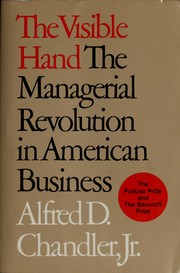
Alfred D. Chandler
Alfred D. Chandler fundamentally reshaped how we understand American capitalism and corporate development. As a business historian whose work bridged academic rigor with compelling narrative, Chandler demonstrated that the evolution of business enterprises wasn’t merely an economic story—it was a cultural and organizational one. His landmark 1977 book The Visible Hand: The Managerial Revolution in American Business earned the Pulitzer Prize for History in 1978, cementing his status as one of the most influential historians of his generation.
The Visible Hand introduced readers to Chandler’s revolutionary thesis: that the modern industrial corporation emerged not through the invisible hand of market forces, but through the visible hand of managerial coordination and strategy. Rather than treating business history as a parade of great industrialists and entrepreneurs, Chandler examined how new management structures, information systems, and hierarchies transformed American industry in the nineteenth and twentieth centuries. His meticulous research and elegant prose made complex organizational theory accessible to general readers while earning the respect of scholars across multiple disciplines.
Chandler’s work established him as an essential voice in understanding how modern institutions actually function. His insistence on studying the internal mechanics of business—how decisions get made, how information flows, how strategy emerges—provided a template for business history that scholars still follow today. The Pulitzer Prize recognized not just a significant historical argument, but a transformative way of seeing the relationship between organization, management, and economic change.