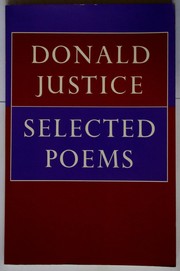
Donald Justice
Donald Justice stands as one of the most technically accomplished and intellectually rigorous American poets of the latter twentieth century. His work is distinguished by a formal precision and emotional restraint that recalls the great modernists, yet his voice remains unmistakably his own—meditative, often elegiac, and marked by a philosophical quietude. Justice’s mastery of traditional forms, from terza rima to the villanelle, never feels antiquated; instead, his formal choices become a means of containing and exploring deep wells of memory, loss, and the passage of time. His influence on generations of younger poets stems not just from the beauty of his individual poems, but from his demonstration that formal rigor and genuine feeling are not opposing forces.
Justice’s most comprehensive collection, Selected Poems, earned him the Pulitzer Prize for Poetry in 1980, a recognition that validated what careful readers had long understood: that his seemingly spare and austere poetry contains multitudes. The collection brought together poems spanning decades, revealing the consistency of his artistic vision and the cumulative power of a body of work built on exacting standards. Beyond his accomplishments as a poet, Justice was also a beloved teacher and a gifted editor, roles through which he shaped the literary landscape and mentored numerous writers who would go on to their own significant careers. His legacy endures as proof that a poet need not court the contemporary moment to speak across generations.