Freeman Dyson
Freeman Dyson stands as one of the most intellectually restless figures of the twentieth century, a theoretical physicist who became equally renowned for his sweeping, humanistic essays on science, technology, and society. After establishing himself as a mathematician of extraordinary gifts—contributing foundational work to quantum electrodynamics and earning recognition from peers like Richard Feynman—Dyson refused to be contained by disciplinary boundaries. Instead, he channeled his scientific rigor into sustained meditations on how technological power shapes human destiny, always writing with a clarity and moral seriousness that made complex ideas accessible to thoughtful lay readers.
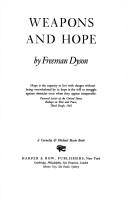
Dyson’s distinctive voice emerged most powerfully in his nonfiction, where he combined scientific precision with philosophical depth and a gift for unexpected connections. His 1984 National Book Critics Circle Award-winning work Weapons and Hope exemplifies this approach, a fearless examination of nuclear weapons that transcends simple advocacy to explore the psychological, historical, and ethical dimensions of humanity’s most destructive invention. The book’s recognition by the National Book Critics Circle reflected something rare: a scientist who could command attention not just from specialists but from the broader literary culture, proving that serious engagement with technology and its consequences could be literature of the highest order.
Throughout a career spanning decades, Dyson remained a contrarian voice willing to challenge prevailing orthodoxies while maintaining genuine humility about the limits of human knowledge. His work invites readers to think alongside him rather than accept conclusions, making him an enduring model for the intellectual essayist who treats readers as partners in exploration rather than audiences to be lectured.