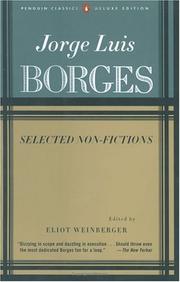
Jorge Luis Borges
Jorge Luis Borges stands as one of the twentieth century’s most intellectually restless and inventive writers, a man who treated literature itself as an infinite library worthy of exploration. The Argentine master crafted deceptively slim volumes that contain entire universes—labyrinths of philosophy, mathematics, and metaphysics wrapped in stories of astonishing compression and surprise. His influence on world literature is immeasurable, having essentially invented the literary form of philosophical fiction and inspired generations of writers to think of narrative as a tool for exploring ideas rather than merely chronicling events. What makes Borges distinctive is his supreme stylistic economy; he could pack more intellectual content into a five-page story than many authors manage in five hundred pages.
Borges’s recognition extends beyond creative works into his considerable achievements as a critic and essayist. His Selected Non-Fictions, which earned the National Book Critics Circle Award for Criticism in 1999, demonstrates the same imaginative rigor and breadth of knowledge that animated his fiction. These essays and prologue selections showcase his ability to write about everything from gaucho poetry to theories of translation to the nature of authorship itself, always with an eye toward uncovering hidden connections and unexpected meanings. This dual mastery—of both fiction and critical thought—represents the fullest expression of Borges’s vision: that reading, thinking, and writing are ultimately the same act, different facets of humanity’s attempt to make sense of an essentially unknowable universe. His work remains essential reading for anyone seeking to understand how literature can function as serious philosophy.