Joseph Brodsky
Joseph Brodsky stands as one of the most consequential literary voices of the late twentieth century, a poet and essayist whose work defies easy categorization and whose influence extends far beyond Russian letters into the broader landscape of world literature. Born in Leningrad and exiled from the Soviet Union in 1972, Brodsky brought to his adopted American home—and later to his role as U.S. Poet Laureate—an uncompromising intellectual rigor and a deeply philosophical approach to both poetry and prose. His writing is marked by a classical erudition, a skepticism toward political orthodoxy of any kind, and a conviction that literature offers moral instruction in a world increasingly hostile to introspection.
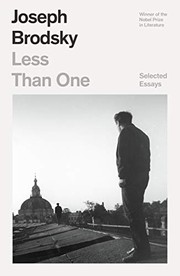
Brodsky’s essay collection Less Than One, which earned the National Book Critics Circle Award for Criticism in 1986, showcases the penetrating analytical mind behind his poetry. These essays reveal an author equally at home discussing Anna Akhmatova, W.H. Auden, or the act of translation itself, always with an eye toward how literature shapes consciousness and conscience. The recognition of Less Than One underscores a crucial aspect of Brodsky’s legacy: he was not merely a poet of extraordinary linguistic precision and emotional depth, but also a critic and theorist whose thoughts on language, exile, and the autonomy of art have proven as vital and enduring as his verse. In both forms, his work insists on the irreducible complexity of human experience and the necessity of aesthetic resistance against the forces—whether totalitarian or commercial—that seek to simplify it.