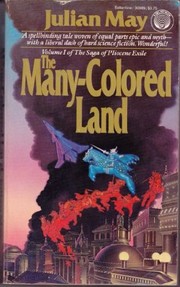
Julian May
Julian May stands as one of science fiction’s most inventive world-builders, a writer whose sprawling imagination has consistently pushed the boundaries of speculative storytelling. Her career spans decades of genre innovation, with a particular gift for constructing intricate future histories that operate on epic scales—the kind of ambitious narratives that demand readers surrender completely to their logic and wonder. May’s work is characterized by meticulous world-building, complex timelines that fold back on themselves, and an intellectual rigor that never sacrifices human drama for conceptual cleverness.
Her breakthrough novel, The Many-Colored Land, exemplifies everything that makes her work compelling: a richly imagined far future where time travel becomes possible, stranding characters across millennia and forcing them to reckon with the consequences of their choices in ways that resonate far beyond mere plot mechanics. The novel’s recognition as the 1982 Locus Award winner for Best Science Fiction Novel cemented May’s position among the field’s most significant voices, validating the kind of ambitious, densely layered storytelling that had begun to define her reputation.
May’s mastery of mythology, technology, and human nature—woven together across multiple interconnected series—reveals an author unafraid to ask big questions about consciousness, evolution, and what happens when humanity reaches beyond its grasp. Her cross-genre appeal and the passionate devotion of her readers speak to her rare ability to engage both the rigorous science fiction community and general readers seeking immersive, thought-provoking narratives.