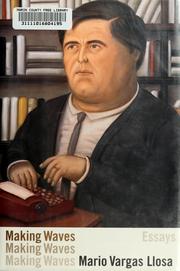
Mario Vargas Llosa
Mario Vargas Llosa stands as one of Latin America’s most commanding literary voices, a writer whose ambition extends across novels, essays, and political commentary with equal virtuosity. Born in Peru and shaped by a life that has spanned continents and ideologies, Vargas Llosa constructs narratives of remarkable formal complexity that grapple with power, corruption, desire, and the gap between personal aspiration and social reality. His fiction is characterized by layered time schemes, shifting perspectives, and a baroque density of detail that rewards close reading, while his essays demonstrate the same analytical rigor he brings to his novels.
Beyond his celebrated fiction, Vargas Llosa has proven himself a formidable critic and cultural commentator. His 1997 National Book Critics Circle Award for Making Waves recognized his sophisticated engagement with literature and ideas, cementing his reputation as an intellectual force who moves fluidly between creating literature and analyzing it. This cross-disciplinary recognition reflects a career in which Vargas Llosa has consistently used his voice—whether through fiction or essay—to interrogate the relationship between art and society, the seductions of power, and the possibilities of individual freedom within constraining social structures. His work remains essential reading for anyone seeking to understand how the novel can be both formally innovative and deeply political.