Mark Strand
Mark Strand stands as one of the most influential American poets of the late twentieth century, a master of spare, luminous verse that explores the spaces between language and silence. His work is characterized by a deceptive simplicity—short, often declarative lines that strip away ornament to reveal profound meditations on absence, time, and the self. Strand’s distinctive style eschews the elaborate metaphysical conceits favored by many of his contemporaries, instead favoring a kind of philosophical minimalism that rewards close attention and repeated readings. His recurring preoccupations with emptiness, loss, and the paradoxes of human consciousness have made him essential reading for anyone seeking to understand contemporary American poetry.
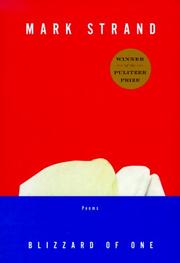
In 1999, Strand’s mastery was recognized with the Pulitzer Prize for Poetry for Blizzard of One, a collection that showcases the culmination of his artistic vision. The poems in this slim but potent volume demonstrate Strand’s ability to transform the ordinary—a question, a gesture, a moment of doubt—into occasions for philosophical inquiry. Rather than relying on biographical narrative or personal confession, Strand constructs a landscape of pure thought, where ideas and emotions circulate like figures moving through snow. The Pulitzer recognition validated what devoted readers had long understood: that Strand’s poetry, with its quietness and precision, contains an entire universe of meaning.