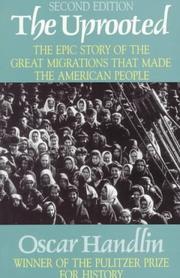
Oscar Handlin
Oscar Handlin fundamentally changed how American historians understood immigration and the immigrant experience. His groundbreaking work The Uprooted, which won the Pulitzer Prize for History in 1952, rejected the notion that immigrants were simply assimilated into a welcoming nation. Instead, Handlin portrayed immigration as a profound rupture—a wrenching departure from home, followed by the disorienting struggle to rebuild lives in an unfamiliar land. The book’s emotional depth and rigorous scholarship made it a landmark in American historical writing, establishing Handlin as a leading voice in social history at a time when the discipline was still dominated by political and military narratives.
Throughout his career, Handlin was drawn to the stories of ordinary people caught in moments of historical transformation. He examined how individuals and families navigated displacement, cultural dislocation, and the search for belonging—themes that resonated far beyond academic circles. His approach combined meticulous archival research with a novelist’s attention to human detail, making his work accessible to general readers while maintaining scholarly authority. Handlin’s insistence on centering the immigrant perspective helped establish immigration history as a central strand of American studies, influencing generations of historians who followed in his wake.