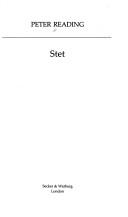
Peter Reading
Peter Reading stands as one of the most intellectually rigorous and formally adventurous poets of his generation, a writer whose work refuses easy categorization or comfort. His poetry is characterized by a restless precision, dense with linguistic play and philosophical inquiry, often employing unconventional typography and fragmented structures to challenge readers’ assumptions about how meaning operates on the page. Reading’s distinctive style—combining technical virtuosity with an almost anthropological eye for contemporary life—has earned him recognition as a significant figure in late twentieth-century British poetry, even as his demanding work has kept him somewhat outside the mainstream literary establishment.
Reading’s achievements were affirmed when his collection Stet took the Costa Book Awards for Poetry in 1986, a recognition that acknowledged both the formal innovation and intellectual substance that characterize his most accomplished work. The title itself—a proofreading term meaning “let it stand”—encapsulates Reading’s broader literary project: an insistence on precision, on the authority of what is written, and on the materiality of language itself. His poetry frequently grapples with themes of textuality, mortality, and the relationship between word and world, often with a dark humor that keeps his philosophical investigations from becoming merely cerebral.
Throughout his career, Reading has maintained an uncompromising commitment to complexity and difficulty, refusing the seductions of accessibility that might have broadened his readership. This stance has made him a figure of particular significance to other serious practitioners of the poetic art, who recognize in his work a model of integrity and linguistic experimentation that continues to challenge and inspire.