Richard Eberhart
Richard Eberhart stands as one of American poetry’s most distinctive voices, a poet whose career spanned nearly seven decades and defied easy categorization. Though he emerged during modernism’s dominance, Eberhart resisted the era’s more austere intellectualism, instead crafting verse that married philosophical inquiry with lyrical accessibility. His work grapples persistently with mortality, spiritual questioning, and the natural world—themes he explored with an almost naive directness that felt increasingly countercultural as the twentieth century progressed. This willingness to ask fundamental questions about existence and consciousness, delivered in a voice both contemplative and unpretentious, became his signature contribution to American letters.
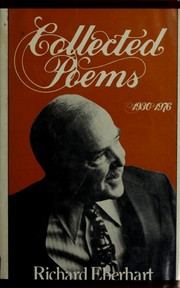
The breadth of Eberhart’s recognition across major awards underscores his significance to the American poetic tradition. His Selected Poems earned the Pulitzer Prize for Poetry in 1966, affirming his status as a major literary figure at a moment when his work had already influenced a generation of younger poets. Over a decade later, the National Book Award honored his Collected Poems, 1930–1976: Including 43 New Poems in 1977, a recognition that spoke not only to the depth of his individual poems but to the remarkable consistency and evolution of his vision across more than four decades of active composition. Few poets achieve such sustained cross-award recognition, a testament to Eberhart’s ability to speak across critical camps and to readers seeking poetry that combined technical sophistication with genuine emotional resonance.