Richard Rhodes
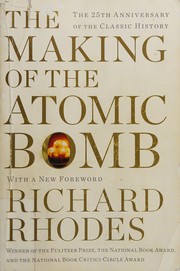
Richard Rhodes stands as one of America’s most consequential narrative historians, a writer who has elevated the nonfiction form to an art that rivals the best literary fiction in both scope and human insight. His magnum opus, The Making of the Atomic Bomb, exemplifies his distinctive approach to historical storytelling—meticulous research married with vivid prose that transforms complex scientific and political history into a gripping human drama. The book’s sweep across decades and continents, its interweaving of personal biography with geopolitical consequence, announced Rhodes as a historian unafraid to tackle the largest questions of the twentieth century.
The dual recognition of The Making of the Atomic Bomb with both the 1987 National Book Critics Circle Award and the 1988 Pulitzer Prize for General Nonfiction underscored what readers already sensed: that Rhodes had created something simultaneously rigorous and readable, scholarly yet accessible. This kind of cross-award recognition is rare and speaks to a work that satisfies both the specialist and the general reader, that achieves both critical and popular validation. Rhodes’s gift lies in his ability to render the abstract—the physics of nuclear fission, the economics of wartime mobilization, the moral weight of scientific discovery—in terms that illuminate rather than obscure, that invite readers into the very human struggles behind world-changing events.