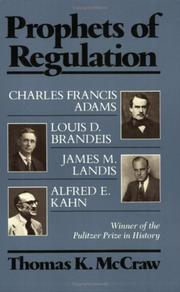
Thomas K. McCraw
Thomas K. McCraw stands as one of America’s most influential business historians, a scholar who fundamentally reshaped how we understand the relationship between government regulation and economic innovation. With a career spanning decades at Harvard Business School, McCraw brought intellectual rigor and narrative flair to subjects that might otherwise remain confined to academic margins. His work demonstrates an uncommon ability to make the architecture of American capitalism both comprehensible and genuinely compelling, revealing the hidden logic behind the institutions that govern our economic lives.
McCraw’s Prophets of Regulation, which won the Pulitzer Prize for History in 1985, exemplifies his signature approach: examining the lives and ideas of pivotal figures—including Louis Brandeis, James Landis, and Alfred Kahn—to illuminate how regulatory frameworks actually took shape in America. Rather than treating regulation as a dry policy matter, McCraw portrayed it as a deeply human story of lawyers, economists, and visionaries wrestling with the fundamental question of how to balance economic freedom with public welfare. This biographical method, grounded in meticulous research, allowed him to argue persuasively that America’s regulatory traditions, whatever their flaws, emerged from genuine intellectual engagement with serious problems.
The Pulitzer recognition validated what McCraw’s peers already knew: that his work transcended the business history category to speak to broader questions about American governance, entrepreneurship, and the role of ideas in shaping institutions. His influence extends well beyond the academy, establishing him as an essential voice for anyone seeking to understand how modern capitalism came to be organized as it is.