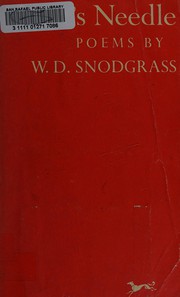
W. D. Snodgrass
W. D. Snodgrass stands as a pivotal figure in postwar American poetry, a writer who helped chart a new emotional terrain for verse at a moment when the literary establishment was still dominated by high modernism’s austere formalism. His breakthrough collection, Heart’s Needle, earned the Pulitzer Prize for Poetry in 1960 and announced the arrival of a major voice—one willing to mine the intimate details of personal life, particularly the ache of estrangement from his daughter, and transform them into poems of startling honesty and technical precision. What made Snodgrass’s achievement especially significant was his refusal to choose between confession and craft; he proved that deeply personal subject matter could coexist with formal rigor, a lesson that would influence countless poets who followed.
Throughout his career, Snodgrass cultivated a deceptively plain-spoken style that belied the careful architecture beneath. His recurring preoccupations—the failures of love and marriage, the passage of time, the relationship between father and child—are explored with a clarity and directness that feels almost revolutionary when measured against the obscurities favored by his contemporaries. Yet this accessibility never slides into mere sentiment; Snodgrass’s work maintains an unflinching quality, a willingness to examine both his own complicity in suffering and his yearning for redemption. His influence extends beyond his own considerable body of work to shape the confessional movement and beyond, establishing that poetry’s power often lies not in grandiose statement but in the faithful rendering of a single moment, a single failure, a single moment of grace.