William Carlos Williams
William Carlos Williams stands as one of American modernism’s most influential voices, a poet who fundamentally reshaped how literature engages with everyday experience. Working as a physician in New Jersey throughout his career, Williams developed a distinctive poetic philosophy rooted in the maxim “no ideas but in things”—a commitment to finding profound meaning in ordinary objects, local landscapes, and the speech patterns of ordinary people. His work rejected the ornate intellectualism of his contemporaries, instead building dense, vivid imagery from wheelbarrows, plums, and the streets of Paterson, New Jersey, his adopted city. This accessible yet formally innovative approach influenced generations of poets and established Williams as a cornerstone of American literary modernism.
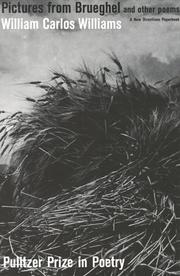
Williams’s major opus, Paterson, stands as his most ambitious work—an experimental five-book poem that weaves together history, local color, and fragmented narrative into a meditation on urban American life. The third book in this sequence, along with his Selected Poems, earned him the 1950 National Book Award for Poetry, recognition that validated his decades-long commitment to a distinctly American poetic voice. His later collection, Pictures from Brueghel, which won the Pulitzer Prize for Poetry in 1963, demonstrated his continued vitality and mastery. These awards confirmed what devoted readers already knew: Williams had fundamentally expanded the possibilities of American poetry, proving that literary greatness could emerge from attentiveness to the local, the overlooked, and the immediate world around us.
-
-
Paterson: Book ThreeandSelected Poems(two books)