William Meredith
William Meredith stands as one of American poetry’s most measured and intellectually rigorous voices, a writer whose career spanned decades of evolving literary landscapes without sacrificing his commitment to clarity and precision. His poetry is marked by a contemplative intelligence that finds profound meaning in everyday observation, drawing readers into moments of quiet revelation. Meredith’s work resists easy categorization—it is neither confessional nor purely formal, but rather occupied a generative middle ground where personal reflection meets philosophical inquiry, where technical mastery serves emotional honesty.
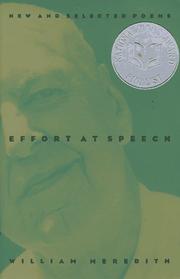
Recognition of his considerable achievements came at the height of his creative maturity. His 1988 Pulitzer Prize for Partial Accounts: New and Selected Poems acknowledged a body of work distinguished by its accumulated wisdom and formal sophistication, while his 1997 National Book Award for Effort at Speech: New and Selected Poems demonstrated the enduring resonance of his voice across nearly two decades. This dual recognition—winning major prizes nearly a decade apart for selected and new work—speaks to Meredith’s rare ability to deepen rather than repeat himself, to sustain a conversation with readers that grew richer with time. His title Effort at Speech proved prophetic: it captures the essential gesture of his poetry, the deliberate labor of finding language adequate to experience, a struggle that yields not certainty but something more valuable—hard-won understanding.
-
-
Partial Accounts: New and Selected Poems